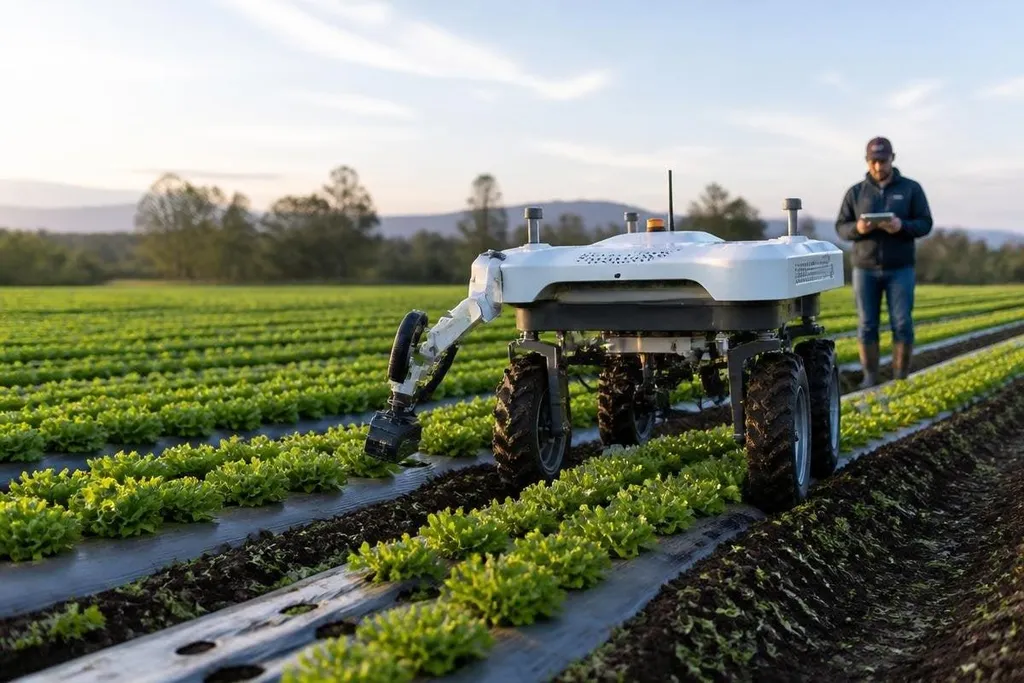
Agricultural robots are moving into fields, orchards, greenhouses, and packing areas because farm work often depends on repeated tasks in difficult conditions. Their value comes from handling those tasks with cameras, sensors, software, and tools built for a narrow job.
- Robots can inspect crops plant by plant.
- Cameras and sensors help machines spot changes humans may miss.
- The main test is useful work in real weather, soil, and crop rows.
Farm work has a difficult shape
A farm is not a clean factory floor. Ground can be wet, uneven, dusty, or covered with plant waste. Crops can also vary in size and position, so a robot must react to the field instead of repeating one exact movement.
That makes agricultural automation different from many factory systems. A factory robot often works beside fixed equipment with known positions. A field robot may need to find a row, avoid a stone, pass around a person, and keep its tool away from the crop.
The task itself matters. A machine that moves between rows may carry tools or supplies. Another may inspect leaves with cameras. A third may remove weeds with a mechanical tool or a targeted spray system. Each machine needs a clear job because general-purpose farm work remains difficult.
Sensors turn crops into data
Cameras give a robot images of leaves, fruit, soil, and weeds. Software can then sort those images and point the machine toward a chosen task. The system may also use GPS, wheel sensors, or LiDAR, which measures distance with light, to work out where it is.
That information changes the work after the robot leaves the field. A grower can use crop images to find areas that need water, inspection, or treatment. The robot becomes part of a loop: it gathers data, a person checks the result, and the next job uses that information.
The limits are easy to miss in a short demonstration. Shadows, dust, rain, blocked views, and similar-looking plants can make image-based decisions harder. A camera may spot a weed, but the machine still needs a tool that can reach it without harming the crop.
A field test needs more than a clear image: it should show the crop, machine, task, and result. Reports on agricultural robots at Robot24.com can connect those details before the next section looks at where these systems can help first.
Where robots can help first
The strongest early uses share three traits: the work repeats, the target can be seen or measured, and a mistake has a manageable cost.
Inspection fits that pattern because cameras can check many plants while a person reviews the findings.
Row navigation also suits machines built for farms. A robot can follow a planned route, stop when its sensors detect an obstacle, and return to a charging point or service area. That can reduce walking and let a worker spend more time on decisions that need judgment.
Harvesting is harder. Fruit can hide behind leaves, ripen at different times, and bruise under too much force. A gripper must find the fruit, choose a safe grip, remove it, and place it in a container. One missed step can damage the crop or slow the whole job.
Cost, safety, and farm fit
A farm robot earns its place through useful hours, not a polished video. The buyer needs to know how much land the machine can cover, what happens when it gets stuck, how often it needs service, and whether a worker can repair it locally.
Safety also changes with the setting. People, animals, tractors, irrigation lines, and temporary equipment may share the same space. A robot needs clear stop controls and a safe response when its sensors lose sight of the route.
I’d buy a farm robot for a narrow task only after seeing its failure procedure and service plan. A machine that handles one job every day can make sense; a machine that needs constant supervision may shift work rather than reduce it.
A practical buying check
Use these checks before treating a farm robot as ready for paid work:
- Name the task: Write down the exact job, crop, field area, and work period.
- Check the route: Test soil, slopes, row spacing, mud, dust, and places where people enter.
- Measure the handoff: Record what a worker must load, inspect, repair, or remove each day.
- Price the downtime: Include charging, spare parts, service visits, and weather delays.
- Watch a full run: Ask to see startup, normal work, obstacle stops, faults, and recovery.
- Set a human role: Decide who checks the machine and who takes control when conditions change.
These checks connect the robot to farm work rather than to a product sheet. They also show where a person remains part of the system.
Agricultural robots will become more useful as their tools, sensors, and service plans match specific crops and working conditions. The next proof is simple: a machine must complete a paid farm task across a full working period, then do it again when the field is wet, uneven, or crowded.